

When researchers handpicked the parents, the kids looked great. When the kids were identified randomly or via gov’t data, the picture reversed. That’s not science – that’s rigged research.
The web is full of articles how Washington State attacks children. This state has even passed laws to allow it to happen…
Man accused of murdering baby he wanted to adopt
Gay couple who showed off picture-perfect family gets 100 years in prison for horrific rape of adopted sons
Queer couple convicted for horrific torture & murder of gay couple’s adopted son
Breaking apart families is what Washington State is known for.


Stutzman’s flower shop with a request: the customer—who is gay—asked Stutzman to provide flowers for his wedding. Stutzman declined, citing her Christian faith’s objections to same-sex marriage, and was eventually charged with violating Washington’s state anti-discrimination statute.

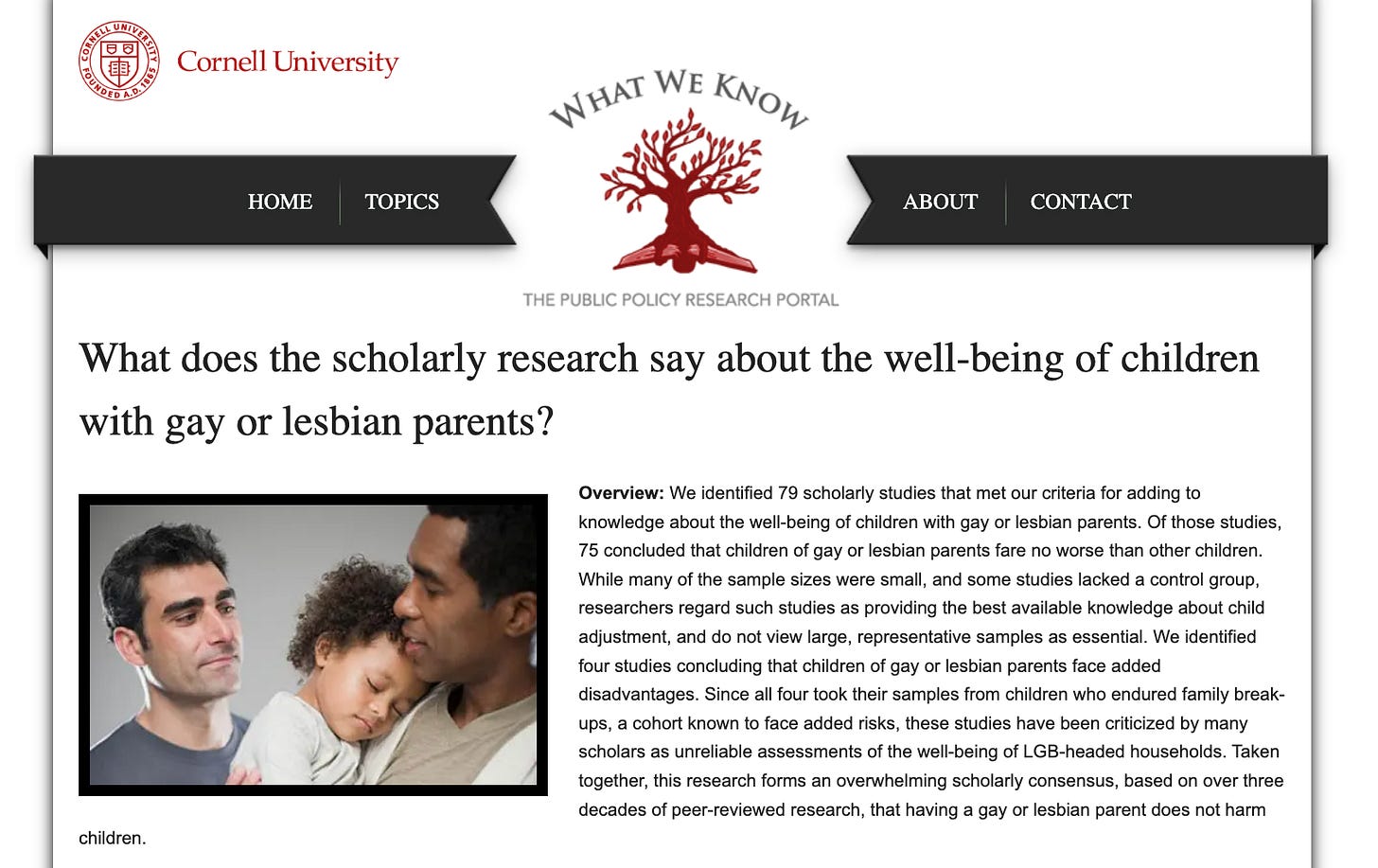
(Them Before Us) — If you’ve ever argued against same-sex “marriage” or same-sex “parenting,” you’ve probably been hit with what your opponent thinks is a mic-drop: a link to Cornell University’s roundup claiming that 75 out of 79 studies show children of gay or lesbian “parents” fare no worse than other children.
The glossy PDF “What Does the Scholarly Research Say?” just happened to be ready on the eve of the Supreme Court’s 2015 decision legalizing gay “marriage.” The message is unmistakable: 75 out of 79 studies say no difference; therefore, the science is settled, the debate is over, and the research supposedly proves there is no harm.
Washington State “Prides” itself, pun intended, on opposing Conservative Christian families in favor of the same-sex couple lifestyle seen today.
- Domestic Partnerships (2007): Before full legalization, Washington enacted domestic partnerships granting limited rights analogous to marriage, including inheritance, hospital visitation, and other legal protections.
- Marriage Equality Legislation (2012): Legislation passing the Washington State Senate and House legalized same-sex marriage, signed by Governor Christine Gregoire in February 2012.
- Referendum 74 (November 6, 2012): Opponents forced a public vote on the legalization statute. Voters approved the law with a 54–46% margin, making same-sex marriage lawfully recognized as of December 6, 2012; first licenses were issued December 9, 2012.
Lorem ipsum dolor sit amet, consectetur adipiscing elit. Ut elit tellus, luctus nec ullamcorper mattis, pulvinar dapibus leo.
Why does Washington state want to show certification for only LGBTQ+-owned businesses?
But once you look past the headline and actually examine the studies themselves, the picture changes dramatically.
Below is a brief summary of what you’ll find when you apply basic scientific standards – the same standards you would apply to any other area of child-wellbeing research.
Most of the 75 “no difference” studies suffer from severe methodological flaws that would disqualify them in any other domain of social science:
First, many participants were aware that the purpose was to investigate same-sex “parenting,” and they may have biased their responses to produce the desired result.
Second, participants were often recruited through networks of friends or advocacy organizations, resulting in samples of same-sex “parents” who were wealthier, more educated, and more socially stable than the general population of same-sex parents.
Third, average sample sizes of fewer than 40 children virtually guaranteed that there would be no statistically significant differences found between groups.
Fourth, vanishingly few studies measured actual child outcomes – such as medical records, report cards, or even the children’s own reports once they were grown. The vast majority relied on parental self-reporting. No surprise that children with two “dads” have fewer externalizing and internalizing problems when “gay father’s report” is the method of data collection.
Pride organizers say sponsors are pulling back amid DEI rollbacks, economic fears
In any field of study, such factors have a major impact on the credibility of the findings. But when you take into account the cultural/political landscape leading up to redefining marriage, it’s clear that something other than scientific inquiry played a role in the same-sex “parenting” outcomes. What was that “something”? Researcher bias. When the outcome is predetermined, the methodology becomes a formality – and the “science” becomes little more than advocacy with footnotes.
Don’t want to take our word for it? The comprehensive 2015 review, “A Review and Critique of Research on Same-Sex Parenting and Adoption,” concluded that – given high parental instability, limited data on adopted children raised by same-sex couples, and the overwhelming reliance on parental self-report – claims of “no differences whatsoever” are “premature.” In other words, ideologically motivated scholars were building a skyscraper of certainty on a foundation of sand.