Communism in Washington State
A Brief History of the Communist Party in Washington State 1919-2002.
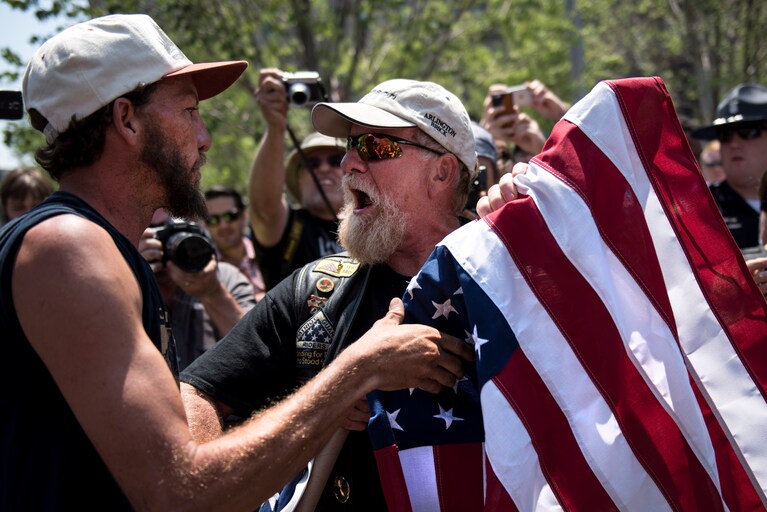
Historical background and timeline of the Communist Party in Washington State.
Communism made a larger impact on Washington than almost any other state. “There are forty-seven states in the Union, and the Soviet of Washington,” Postmaster General James Farley joked in 1936. The remark, for all its exaggeration, had some foundation.
The Communist movement, founded in 1919, caught on quickly in the Pacific Northwest, picking up members from the fading Industrial Workers of the World and Socialist Party. In the 1930s the CP played key roles in the strikes and campaigns that built some of the region’s most powerful unions and used that base to influence other institutions. The Washington Commonwealth Federation, the Washington Pension Union and to some extent the state’s Democratic party organization responded to these popular front initiatives. Running as Democrats, Communists won some important public offices, including a seat in Congress.
During the Cold War the issue of Communism and the prominent role of the Party in the affairs of Washington state became a powerful weapon for conservatives. The state’s Red Scare began in 1947 and party members were soon driven out of most positions of influence. The purges took a heavy toll in jobs lost, families broken up, and organizations destroyed. Yet the CP survived the hard years and revived slightly in the 1960s. Although faced with the problem of aging members and declining numbers, the Party remained active through the end of the 20th century, working mostly in quiet ways with various movements and projects involving labor, race, gender, and other social justice issues.
A Brief History of the Communist Party in Washington State 1919-2002
Here in nine chapters is the decade by decade story of the CP in one of the states where the party made its greatest impact. For a quick overview start with the timeline created by Marian Spath and Gordon Black. Then read the rest sequentially as chronological chapters or skip around.
Timeline
Click image to enlarge.
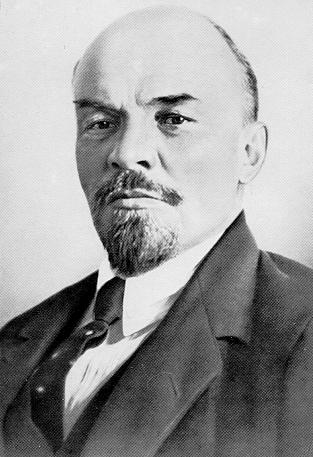
Vladimir Lenin, architect of the 1917 Russian Bolshevik Revolution
The Bolsheviks unite with Soviets established in various Russian cities to take control of the government in the October Revolution. Trotsky and Vladimir Lenin are architects of the revolution. The Second All-Russia Congress of Soviets leads to the creation of the Russian Federated Soviet Socialist Republic. A peace settlement is reached with Germany.
United States enters the war.
First “Red Scare” in the US; radicals, socialists and IWW members are targeted in raids.
Armistice in the Great War.
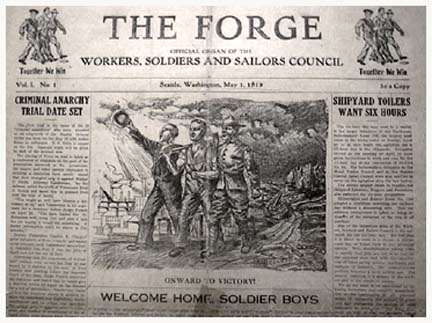
February: The first city-wide strike to occur in the United States begins: the Seattle General Strike.
March: First Communist International (Comitern), composed of Communists and radical socialists from around the world, including the United States, meets in Moscow. In the United States, socialists aligning with the Comiterns pledge allegiance to the revolutionary overthrow of the capitalist system, break from the Socialist Party of Eugene Debs to form the Communist Party of America and the Communist Labor Party, which later merge.
November: An IWW hall is attacked by military veterans during an Armistice Day parade in Centralia. Five veterans are killed by gunfire; a mob breaks into the city jail and pulls out the perceived IWW leader, who was hanged, shot and mutilated. The state of Washington passes a law banning the IWW. In a subsequent trial, seven Wobblies are convicted of murder.
Continued persecution of Communists and “reds,” including the IWW.
Click image to enlarge.
Comintern pressures rival communist parties to unite, form Workers Party
Workers Party exerts influence on political coalitions, labor councils
Lenin dies
AFL orders Seattle Central Labor Council to follow union governance by eliminating Communist issues
The Ku Klux Klan stages massive rally in Issaquah on July 26, attended by an estimated crowd of 13,000.
Joseph Stalin adopts the principle of socialism in one country, a departure from the doctrine of the earlier Internationals.
Seattle Central Labor Council completes expulsion of Communist members
Washington courts rule that Workers Party candidates may appear on ballot
Sixth World Conference of Communist Parties calls for period of revolutionary action
Stock market crashes.
CPUSA launches Trade Union Unity League
CPUSA launches Unemployed Councils, calls for unemployment insurance, seven-hour day, and recognition of Soviet Union.
Unemployed Council forms in Seattle
Socialists form rival Unemployed Citizens League
Scottsboro Boys verdict
The Vanguard begins publication
Click image to enlarge.
March of unemployment groups on Olympia ends in scuffles between rival organizations
Washington state unemployment peaks at more than 25 percent
Cannery and Agricultural Workers’ Industrial Union forms
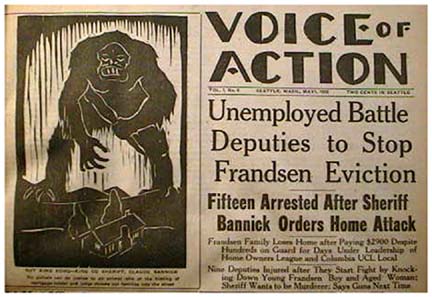
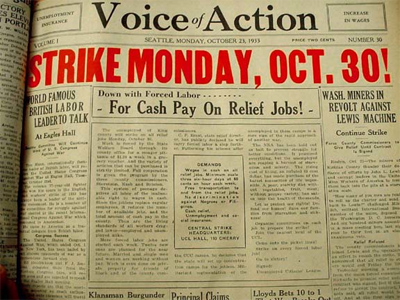
Voice of Action begins publishing
CP defends Ted Jordan in race-linked murder trial in Portland, Oregon
West Coast waterfront strike leads to police violence against strikers in San Francisco and Seattle
Revels Cayton starts Seattle chapter of League for Struggle for Negro Rights, runs for Seattle City Council
Washington Commonwealth Federation forms
Local 751 of International Association of Machinists forms
Local 401 of American Federation of Teachers forms on UW campus
Seventh World Congress of Communist Parties advocates popular front alliances
Terry Pettus organizes chapter of American Newspaper Guild
Guild strikes Seattle Post-Intelligencer
International Woodworkers of America created to encompass many lumber industry unions
Click image to enlarge.
Harry Bridges leads west-coast longshoremen into CIO. Union renamed International Longshoremen’s and Warehousemen’s
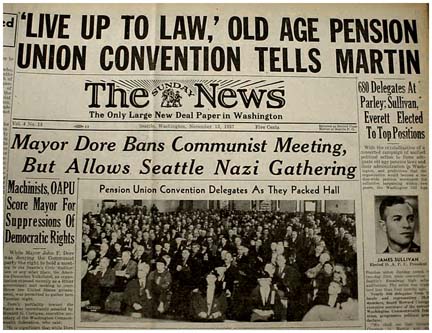
Washington Pension Union forms
Communist Party membership peaks at close to 100,000 nationwide, about 3,000 in District 12
Nazi-Soviet non-aggression pact
State Representative Underwood requests investigation of “communist activities” at UW
Smith Act makes it a crime to advocate the overthrow of the US government
Washington Commonwealth Federation disbanded
John Daschbach founds Washington Civil Rights Congress
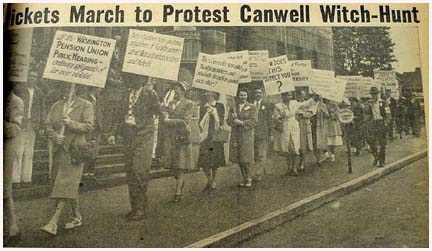
The state’s Joint Legislative Fact-Finding Committee on Un-American Activities is set up to investigate the influence and presence of Communists in state politics.
Click image to enlarge.
Officers of Cannery Workers’ and Farm Laborers’ Union arrested as Communists, scheduled for deportation
Three UW professors dismissed for Communist ties
Cannery Workers’ and Farm Laborers’ Union affiliates with International Longshoremen’s and Warehousemen’s Union
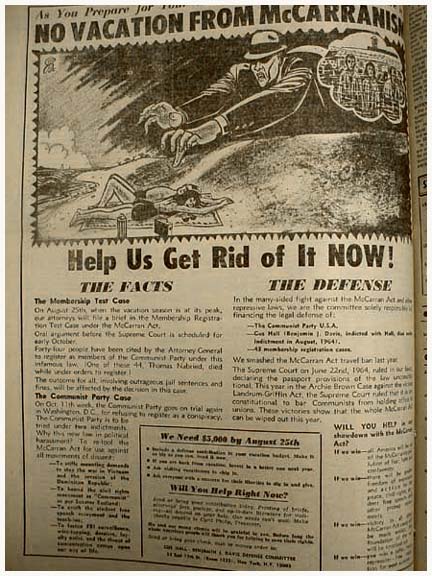
Congress passes McCarran-Walter Internal Security Act to monitor Communists
In landmark case, US Supreme Court rules that Cannery Union officers cannot be deported.
Seven union and civil rights activists in Seattle are charged with conspiracy for attending Communist Party meetings under the Smith Act. The seven include established leaders of the Communist Party in Washington - Henry Huff, John Daschbach, William Pennock, Paul Bowen, Karly Larsen, Terry Pettus and Barbara Hartle.
Barbara Hartle, late of Seattle Seven, becomes FBI informant
Click image to enlarge.
Disgruntled party activist Eugene Dennett testifies against Party
UW professor fired for not signing loyalty oath
Gus Hall prohibited from speaking on UW campus
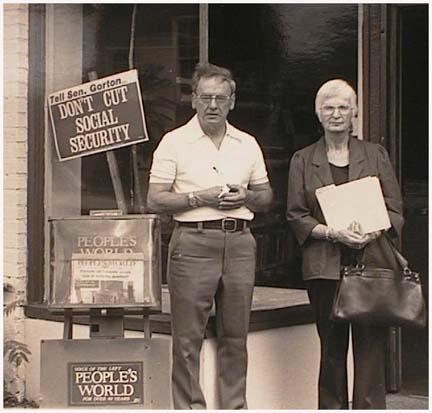
Washington Pension Union officially declared dissolved
Eugene Roebel arrested and fired from shipyard job in McCarran Act case
Click image to enlarge.
Subversive Activities Control Board investigates Washington Committee for Protection of Foreign Born
George Wallace allowed to speak on UW campus
UW students successfully demand abolition of ban on Communists speaking on campus
Henry Winston, national Communist Party leader, permitted to speak at UW
Milford Sutherland runs for Washington State governorship.
Washington Communist Party engages in campaigns on behalf of Native Americans, Seattle Women for Peace, Central District
Angela Davis fired from UCLA professorship
People before Profits Center opens in Seattle
B.J. Mangaoang becames chair of state Communist Party
Marion Kinney runs for State Legislature as a Communist
Kistler runs for State Legislature
B.J. Mangaoang runs for mayor of Seattle
Click image to enlarge.
Eastern European communist bloc countries collapse
BJ Mangaoang lauded in Seattle newspaper for her leadership. She reports less than 200 Party members State-wide.
Mark Jenkins play, All Powers Necessary and Convenient, examining the 1948 Canwell Committee hearings is staged by UW.
Seattle Communist Party office closed
Marc Brodine replaces B.J. Mangaoang as chair of State Party and is elected to the National Committee
Brodine reports state membership at 60